
Types of Material Handling Equipment and Their Uses: A Comprehensive Guide
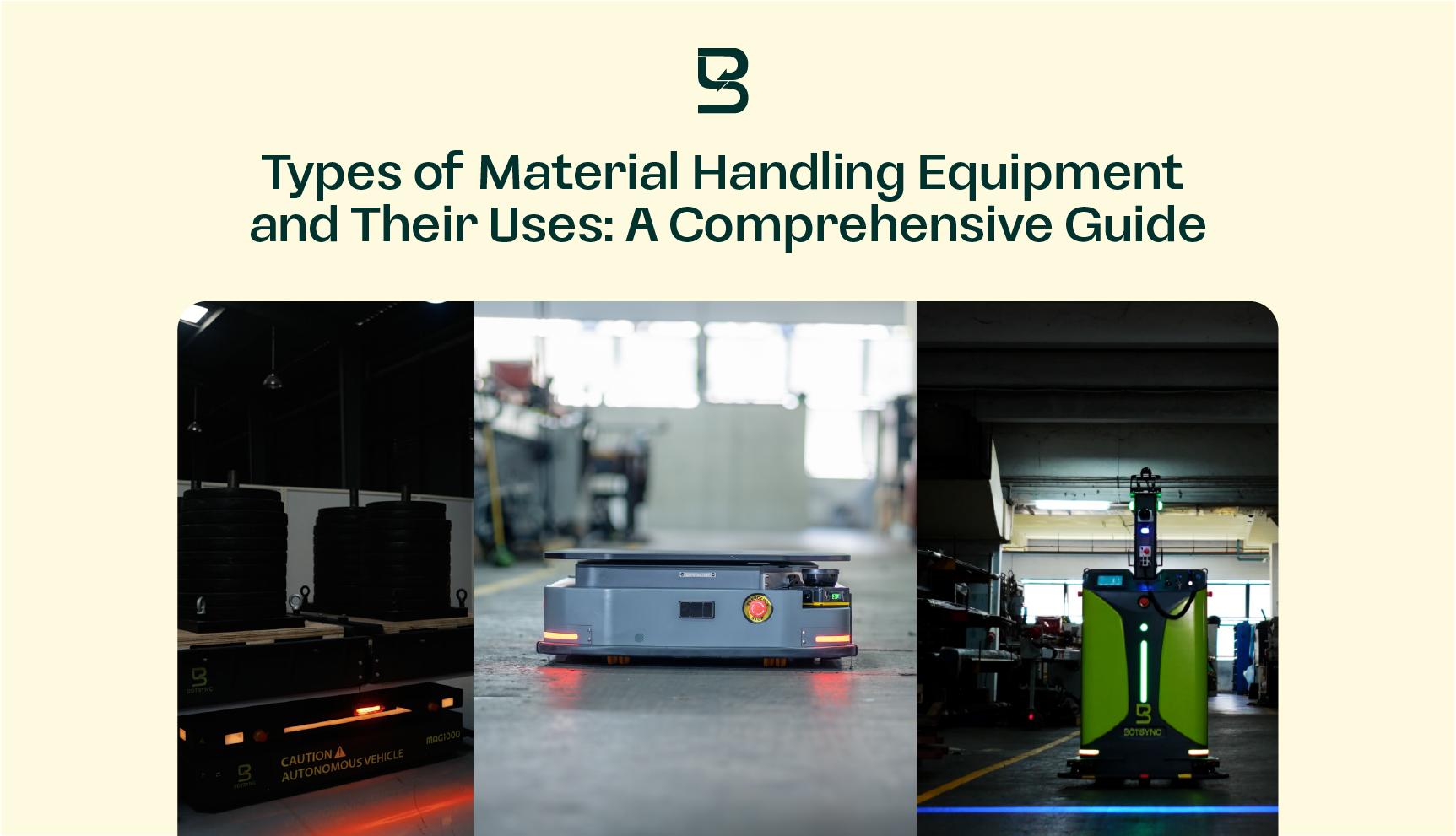
Complete Guide to Material Handling Equipment types: Forklifts, AMRs, Conveyors, AS/RS & more. Learn uses and applications from Botsync's automation experts.
Table of Contents
- –1. Four Main Categories of Material Handling Equipment
- –2. Storage and Handling Equipment
- –3. Industrial Trucks
- –4. Bulk Material Handling Equipment
- –5. Engineered Systems and Automated Equipment
- –6. How to Choose the Right Material Handling Equipment
- –7. Material Handling Equipment by Industry
- –8. Frequently Asked Questions
Key Takeaways
- –1. Material handling equipment helps move, store, and manage materials efficiently.
- –2. The right equipment depends on the material, volume, layout, and operational needs.
- –3. Forklifts, pallet jacks, and tuggers are widely used for internal material movement.
- –4. AMRs, AGVs, AS/RS, and conveyors can automate repetitive material handling tasks.
- –5. Automation can improve efficiency, reduce labor dependency, and support scalable operations.
Material handling equipment refers to the mechanical, automated, or manual tools designed to move, store, protect, and control goods throughout manufacturing, warehousing, and distribution operations. Choosing the right equipment directly determines throughput, safety, and long-term operating costs.
Four Main Categories of Material Handling Equipment
Before choosing specific equipment, it helps to understand how everything fits into four broad categories.
1. Storage and Handling Equipment
Storage equipment maximises space, organises inventory, and protects goods between movement stages. Selection depends on product dimensions, weight, turnover rate, picking frequency, and ceiling height.
a) Racks and Shelving
Permanent or semi-permanent structures for organising materials at scale. Pallet racks come in selective, drive-in, and push-back configurations. Cantilever racks suit long or irregularly shaped items. Standard shelving handles lighter-duty storage. Weight capacities typically range from 2,500 to 5,000+ lbs per level, with heights reaching 8 to 30+ feet.
b) Pallets and Containers
Pallets are the foundation of warehousing. Wood is most common, plastic offers durability and hygiene, and metal suits heavy-duty applications. Standard sizes are 48"×40" for US operations and 42"×42" for telecom and paint industries. Containers include stackable plastic bins, lidded totes for batch storage, and large bulk containers for high-volume inventory.
c) Mezzanines
Elevated platforms that create an intermediate level between floor and ceiling, effectively doubling usable space without building expansion. Available in structural welded steel, rack-supported, and modular relocatable configurations. Most practical in facilities with ceiling heights of 20 feet or more.
2. Industrial Trucks
The workhorses of material handling, industrial trucks transport materials horizontally and vertically across facilities. Selection depends on load weight, lift height, aisle width, indoor/outdoor use, and fuel type.
a) Forklifts (Powered Industrial Trucks)
The most recognisable material handling equipment. Forklifts lift and transport palletised loads across warehouses and loading docks. Types include counterbalance, reach trucks for narrow aisles, order pickers for elevated picking, and rough-terrain variants for outdoor use.
b) Manual Pallet Jacks and Hand Trucks
Manual pallet jacks slide under pallets and use a hydraulic pump to lift loads inches off the ground. Typical capacity runs 4,000 to 6,000 lbs. Best suited for short-distance movement on smooth floors. Hand trucks handle smaller, lighter loads in retail and light distribution environments.
c) Tuggers and Specialty Trucks
Tow tractors pull multiple carts or trailers in train configurations rather than lifting. Suited to long-distance internal transport, inter-building moves, and line-side delivery. Common in automotive manufacturing, airports, and hospitals where high-volume, continuous movement is required.
3. Bulk Material Handling Equipment
Bulk handling manages continuous or batch flows of loose, unpackaged materials including grain, ore, aggregates, and powders. Unlike unit handling which deals with pallets and boxes, bulk systems are designed for volume and flow.
a) Conveyors for Bulk Materials
Belt conveyors, screw conveyors, and bucket elevators move loose materials continuously between processing stages. Common in food processing, agriculture, and mining. Designed for high throughput with minimal manual intervention.
b) Hoppers, Silos, and Storage
Hoppers collect and meter bulk materials at transfer points. Silos store large quantities of grain, powder, or aggregates for extended periods. Both are critical in facilities where continuous feed into processing lines must be maintained without interruption.
4. Engineered Systems and Automated Equipment
Fully and semi-automated material handling solutions that integrate hardware with software to minimise manual intervention. The key characteristics include automation, WMS/ERP integration, scalability, and 24/7 operation capability.
a) Autonomous Mobile Robots (AMRs)
Self-navigating robots that transport pallets, cages, and trolleys without predefined paths. AMRs use onboard sensors, cameras, and AI to map environments dynamically and reroute around obstacles. They integrate with orchestration platforms like SyncOS™ to coordinate multi-vendor fleets under a single control layer. Advantages include flexibility, fast deployment, and scalability. Limitations include higher per-unit cost and dependence on software infrastructure.
b) Automated Guided Vehicles (AGVs)
Follow fixed paths via wire guidance, magnetic tape, or laser systems. More predictable than AMRs in structured environments but less flexible when layouts change. Lower software complexity makes them easier to maintain in stable operations. Best suited to repetitive, high-volume routes with minimal variation.
c) Automated Storage and Retrieval Systems (AS/RS)
High-density automated storage using robotic cranes or shuttle systems to store and retrieve inventory. Maximises vertical space, reduces picking errors, and operates continuously. High upfront cost but strong ROI in high-SKU, high-volume distribution environments.
d) Conveyor and Sortation Systems
Automated transport for unit loads including boxes, totes, and packages. Sortation systems route items to correct destinations using barcode scanning or RFID. Best suited to e-commerce fulfilment and parcel distribution where high-speed, high-accuracy sorting is critical.
How to Choose the Right Material Handling Equipment
Selecting equipment requires matching capabilities to operational requirements across five criteria:
1. Material Characteristics: What are you moving? Heavy pallets suit forklifts or AMRs. Loose grain needs conveyors. Small parts belong in bins and shelving. Fragility and packaging type narrow the options further.
2. Throughput Requirements: Volume per hour and per shift determines whether automation is justified. Under 100 pallets per day favours manual equipment. Above 500 pallets per day makes AMRs and conveyors the practical choice.
3. Facility Layout: Ceiling height determines rack height and forklift mast type. Narrow aisles point toward reaching trucks or AMRs. Floor condition limits options for wheeled equipment on uneven surfaces.
4. Labor Availability and Cost: Labor shortages and high labor costs improve automation ROI significantly. Seasonal peaks can be managed with rentals or scalable AMR deployments that expand and contract with demand.
5. Integration and Scalability: Does the equipment connect to your WMS or ERP? AMRs scale incrementally. Conveyors do not. Vendor lock-in risk should be evaluated before committing to proprietary systems.
Material Handling Equipment by Industry
Different industries prioritise different equipment based on their specific material handling challenges.
a) Manufacturing
Line-side delivery, just-in-time material flow, and mixed payload handling drive equipment selection. AMRs and tuggers handle internal transport. AS/RS manages parts storage. Forklifts remain common for loading and unloading at dock level.
b) Warehousing and Distribution
Speed and accuracy define requirements. Conveyor and sortation systems handle high-volume order fulfilment. Reach trucks and AMRs manage inventory movement. AS/RS maximises storage density in high-SKU environments.
c) Food and Beverage
Hygiene, temperature control, and continuous flow are priorities. Plastic pallets and stainless steel equipment meet sanitation requirements. AMRs handle 24/7 movement across production and cold storage zones without fatigue or contamination risk.
Conclusion
Material handling equipment spans a wide spectrum from simple shelving to fully autonomous robotic systems. The right choice depends on what you are moving, how much, how fast, and what infrastructure you already have. For operations exploring automated material handling, AMRs offer the most flexible and scalable entry point, particularly when coordinated through a vendor-agnostic platform like SyncOS™ that integrates with existing systems without requiring infrastructure replacement. If you are evaluating your options, the Botsync team can help you identify the right fit for your operation.
Frequently Asked Questions
1. What are the four main types of material handling equipment?
The four categories are Storage and Handling Equipment, Industrial Trucks, Bulk Material Handling Equipment, and Engineered/Automated Systems. Each addresses a different stage of material movement from storage and organisation through to fully automated transport and retrieval.
2. When should I choose AMRs over forklifts?
AMRs are the better choice when aisle space is limited, labor availability is low, routes change frequently, or you need to scale the fleet without adding headcount. Forklifts remain more practical for heavy outdoor loads, dock operations, and facilities where infrastructure investment in AMR software is not yet justified.
3. Can automated equipment work in my existing warehouse?
Yes. AMRs in particular are designed for brownfield deployment, meaning they operate within existing layouts without infrastructure changes. Platforms like SyncOS™ integrate with existing WMS and ERP systems, allowing automation to layer onto current operations rather than replace them.
4. How much does material handling equipment cost?
Manual equipment like pallet jacks starts at a few hundred dollars. Forklifts range from $20,000 to $80,000+. AMRs typically range from $30,000 to $100,000+ per unit depending on payload and capability. AS/RS systems can run into the millions. Total cost of ownership, factoring in labor savings and uptime, determines true ROI.
5. What's the difference between AGVs and AMRs?
AGVs follow fixed, pre-programmed paths using magnetic tape or wire guidance. AMRs navigate dynamically using onboard sensors and AI, rerouting around obstacles in real time. AMRs are more flexible and faster to deploy. AGVs are more predictable in highly structured, stable environments.
6. How do I know which equipment is right for my operation?
The right equipment becomes clearer once you understand your own operation. Start by defining what you are moving, how much of it, and how frequently. Then factor in your facility layout, labor situation, and whether the equipment needs to connect to existing WMS or ERP systems. For complex environments, speaking with an automation specialist before purchasing helps avoid costly mismatches.
Storage and Handling Equipment
Storage and Handling Equipment forms the backbone of any facility. Racks, shelving, bins, pallets, and mezzanines don't move materials themselves, but they organise and protect inventory between movement stages, making everything else more efficient.
Industrial Trucks
Industrial Trucks are the most visible category on any warehouse floor. From manual hand trucks and pallet jacks to powered forklifts and reach trucks, these are the vehicles that physically move materials horizontally and vertically within a facility.
Bulk Material Handling Equipment
Bulk Material Handling Equipment is designed for a completely different challenge viz. managing large, continuous volumes of loose, unpackaged materials like grain, powder, or aggregates. Conveyors, hoppers, silos, and bucket elevators are the primary tools here, common in agriculture, mining, and food processing.
Engineered and Automated Systems
Engineered and Automated Systems represent the most sophisticated category. AS/RS, AGVs, AMRs, and sortation systems operate with minimal human intervention, integrate with WMS and ERP software, and run 24/7. They carry the highest upfront cost but deliver the strongest long-term ROI in high-volume operations.